Maison X
- Date
- February 2026
- Venue
- Lausanne
- Format
- Collective installation
- Artists
- Collectif ACA
Leah Linh
Marlène Grand
Simone Nicola Filippo
Noémie Balazs
Levi Abraham
Romain Carré
Asia Cantalupo
Christophe Ascençao
Odile Fragnière - Curators
- Tamarine Schreiber
Marek M. Chojecki
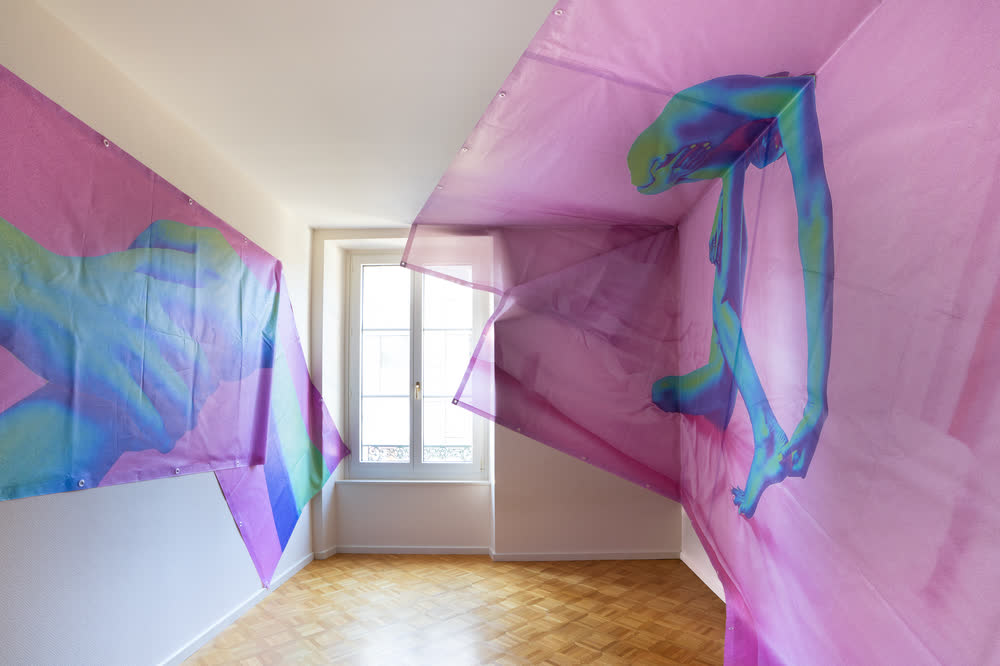
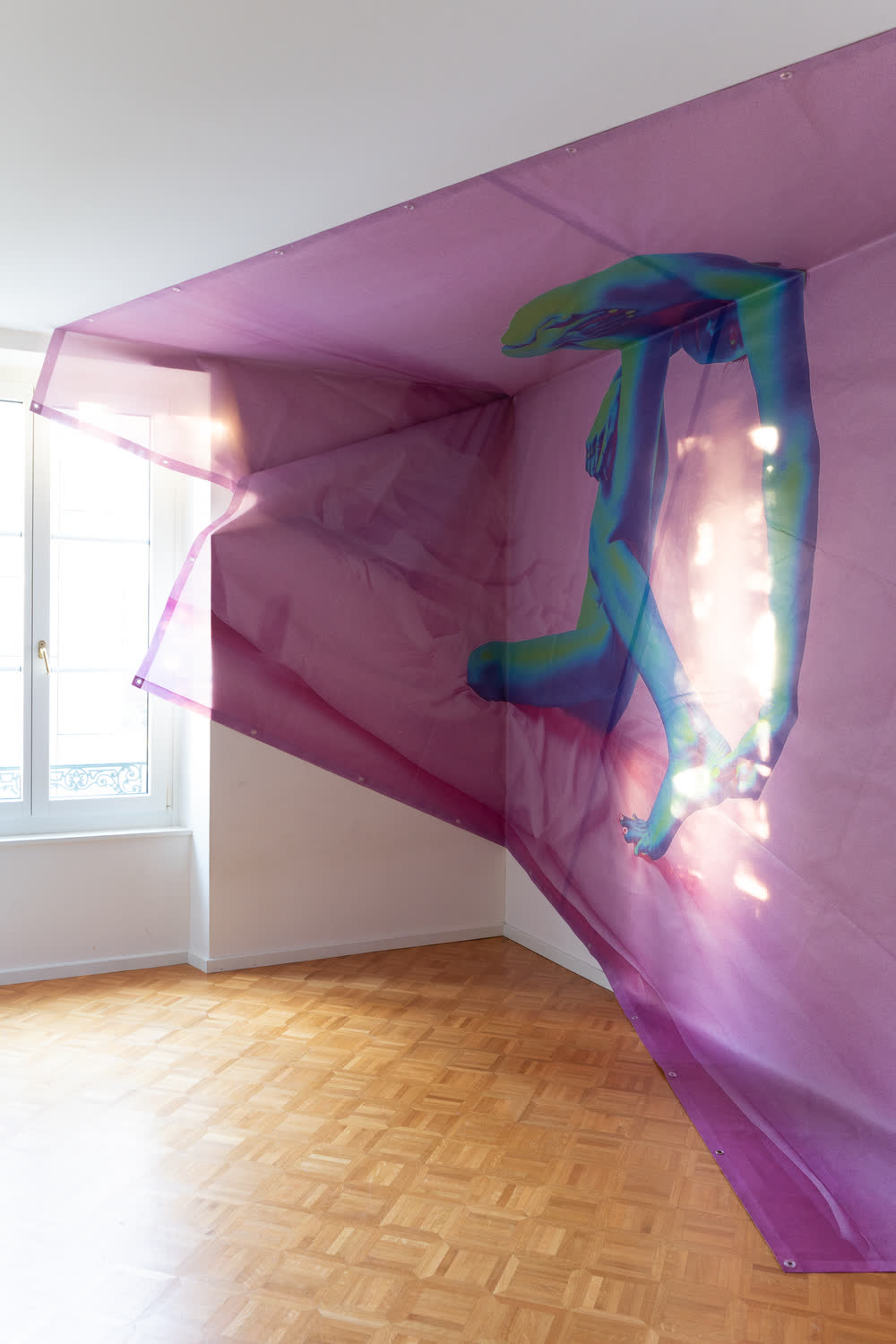
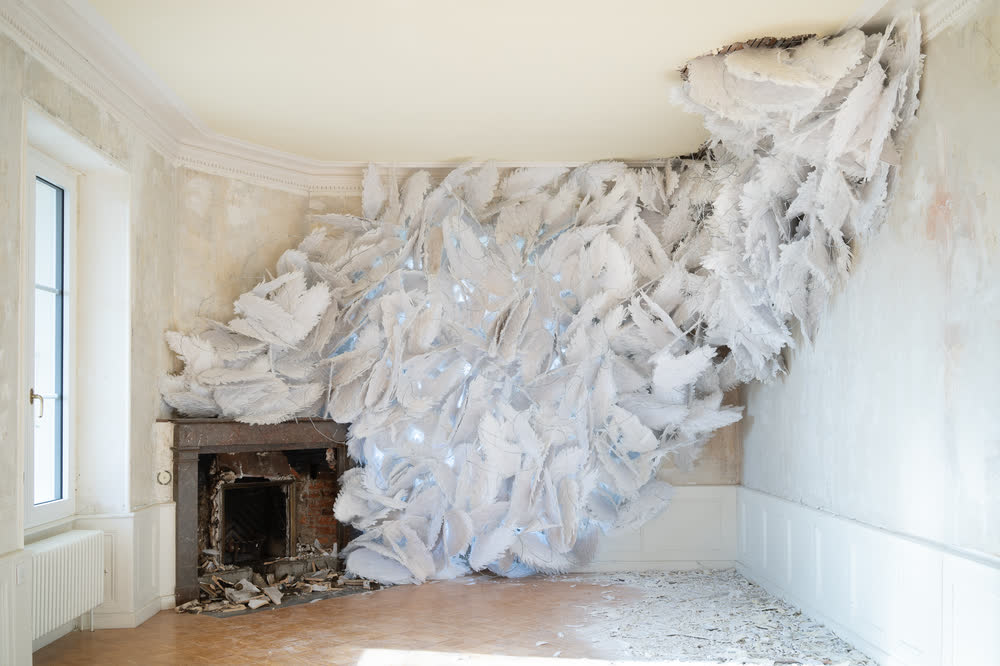
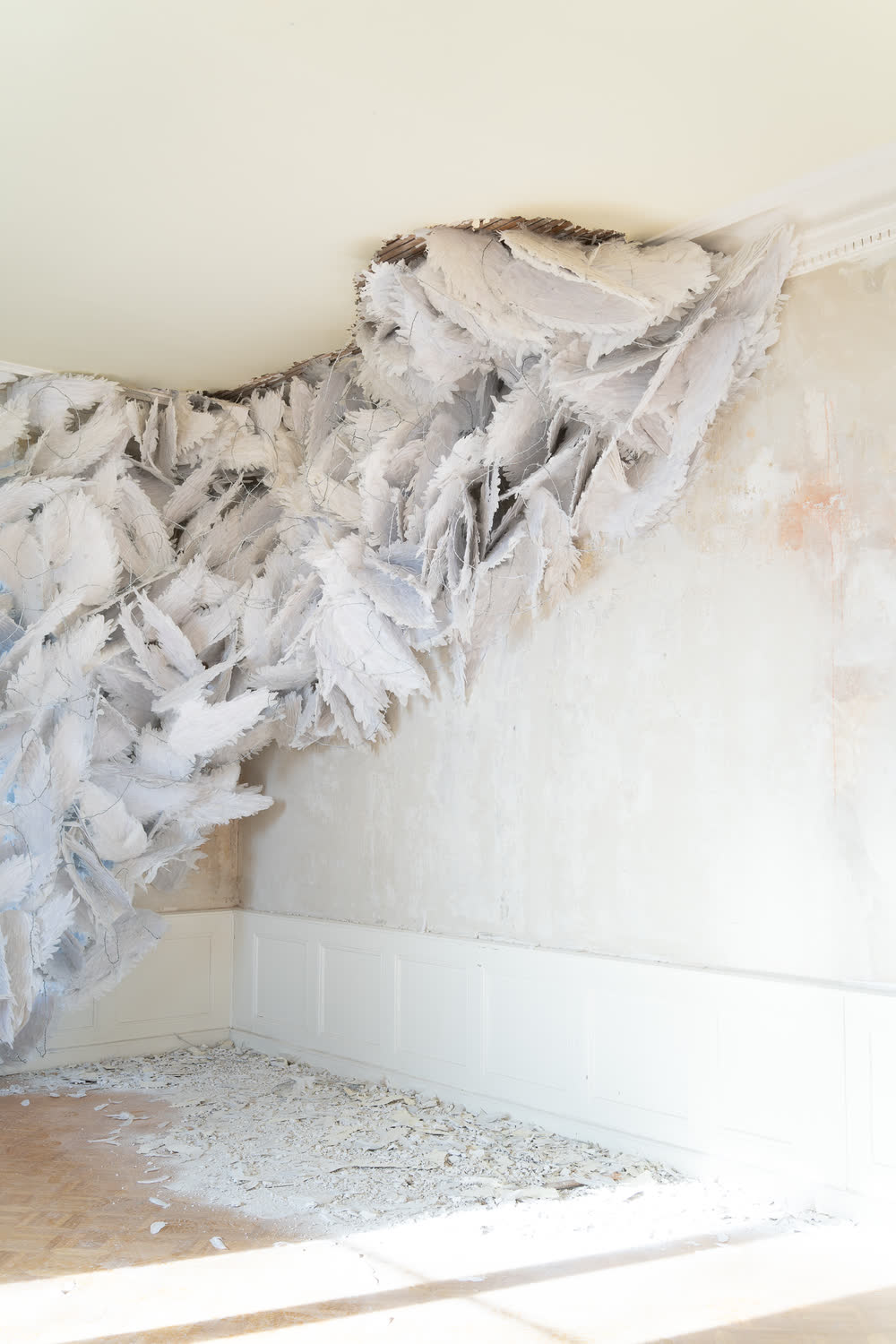
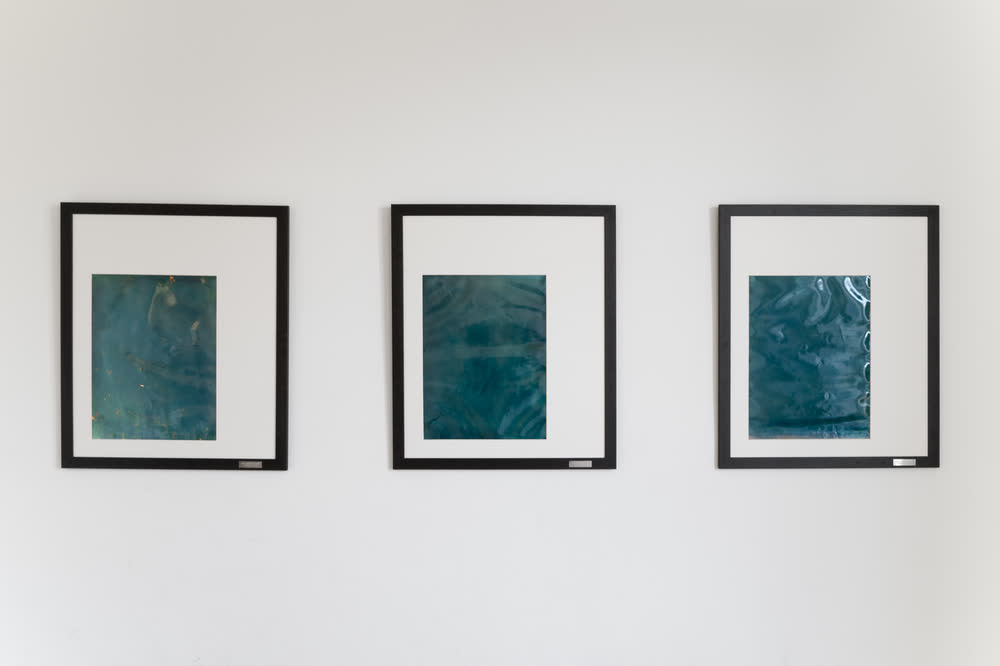
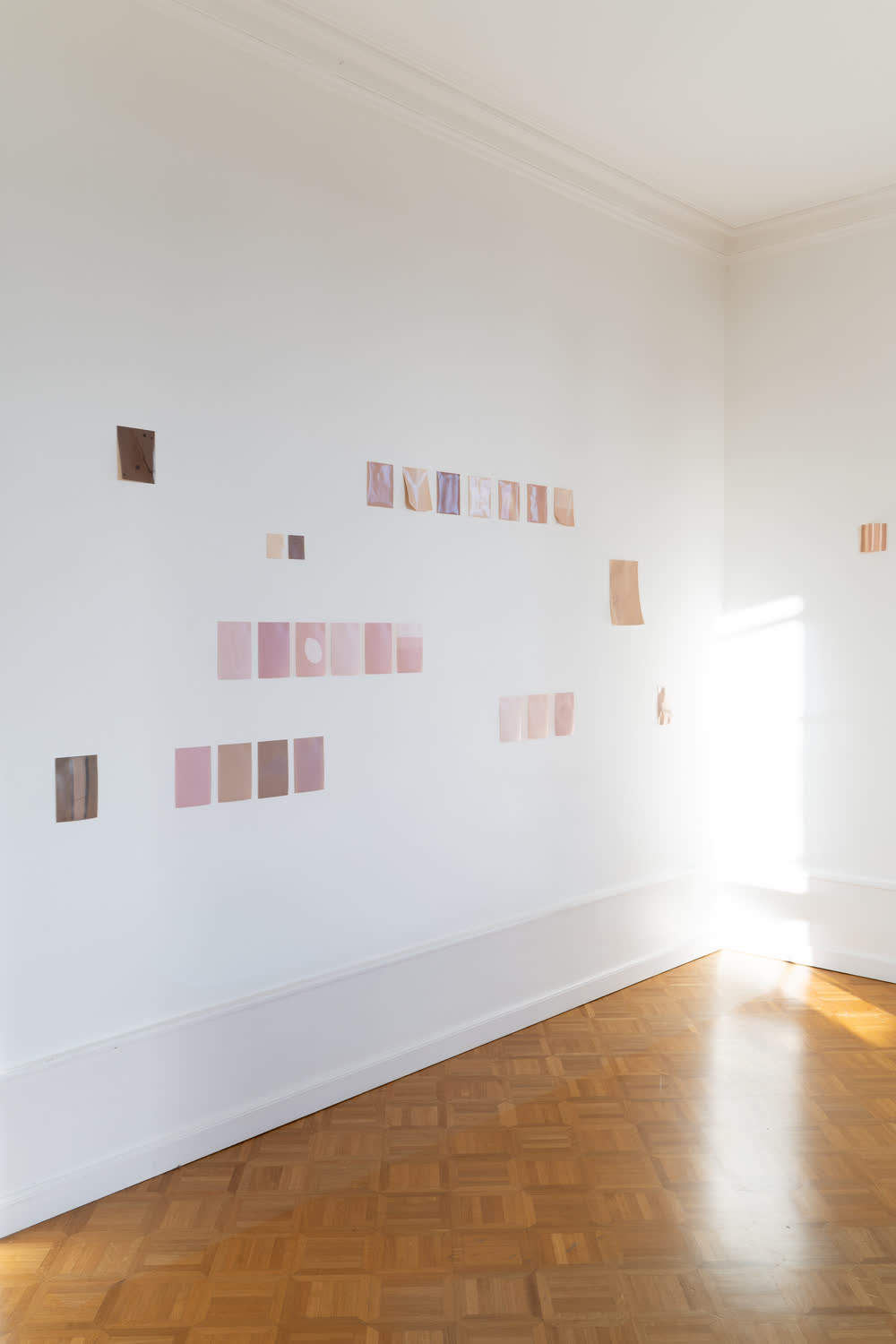
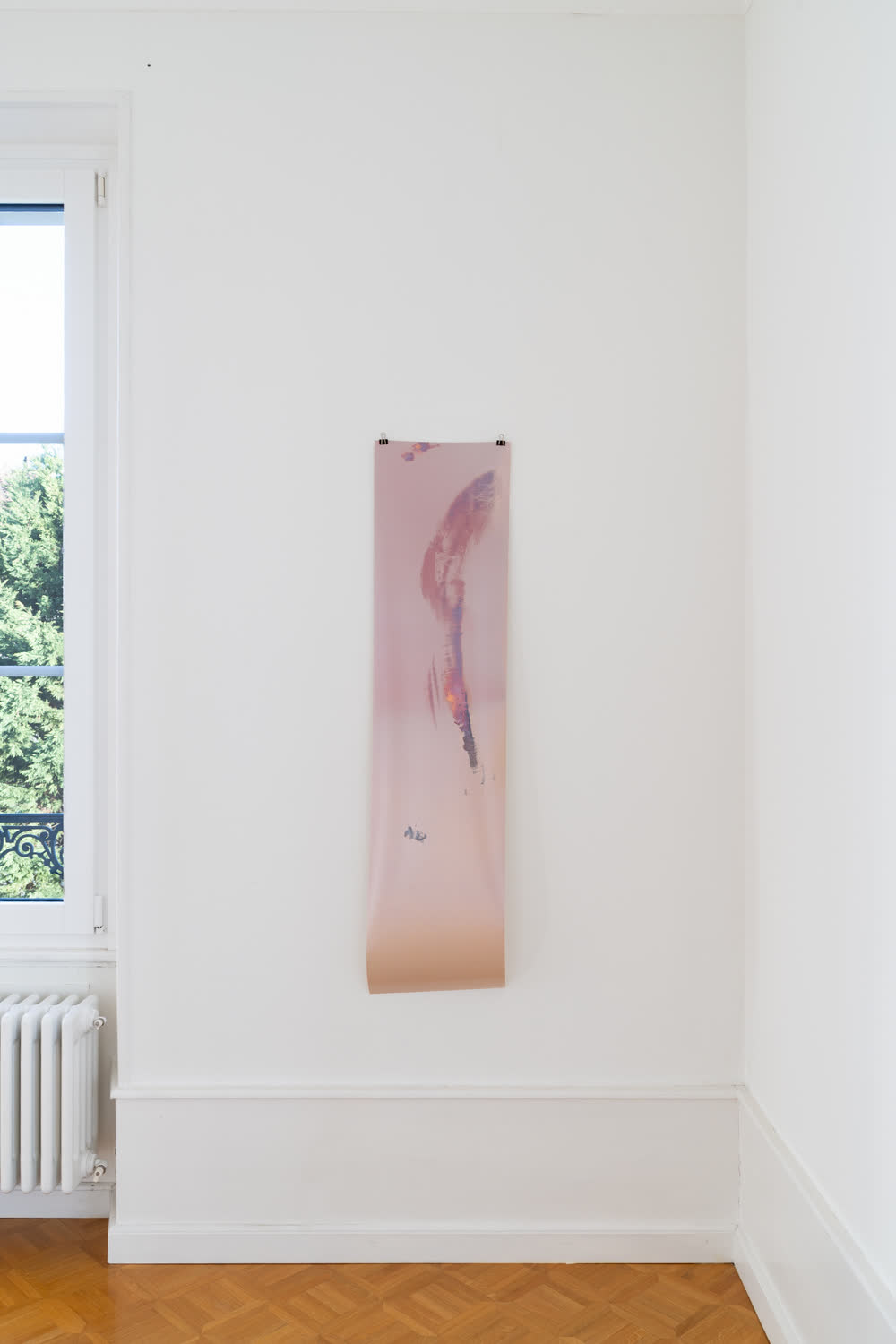
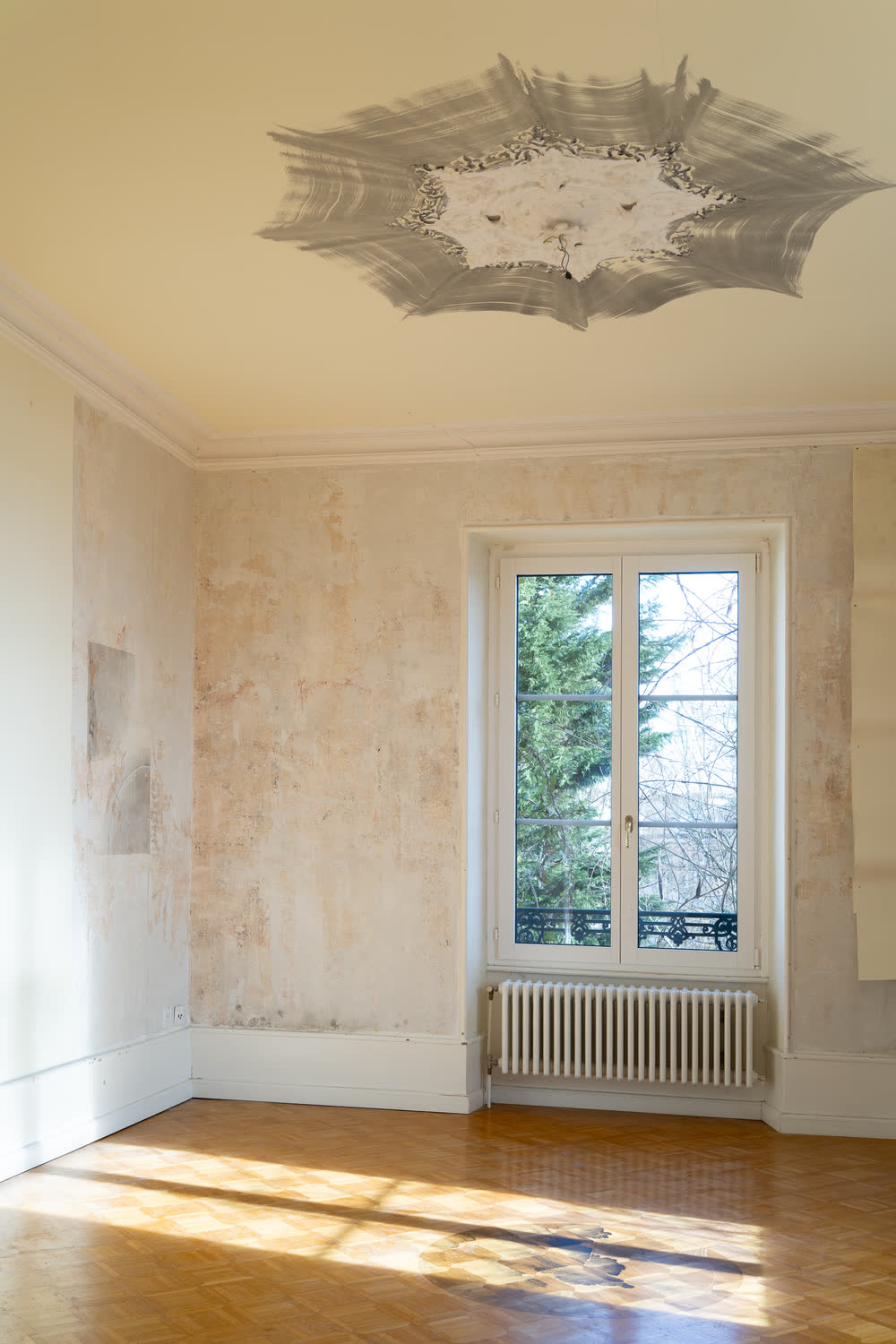
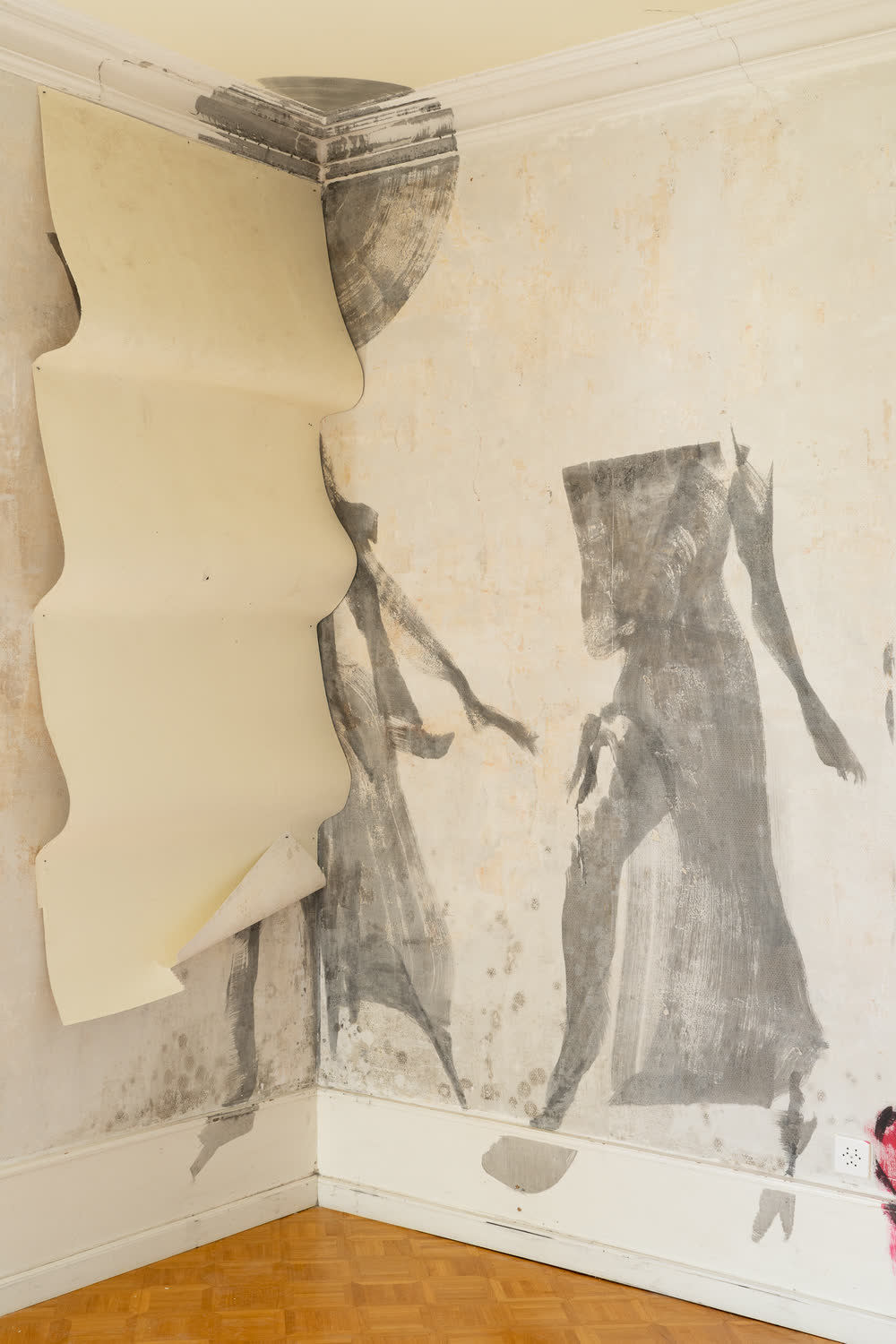
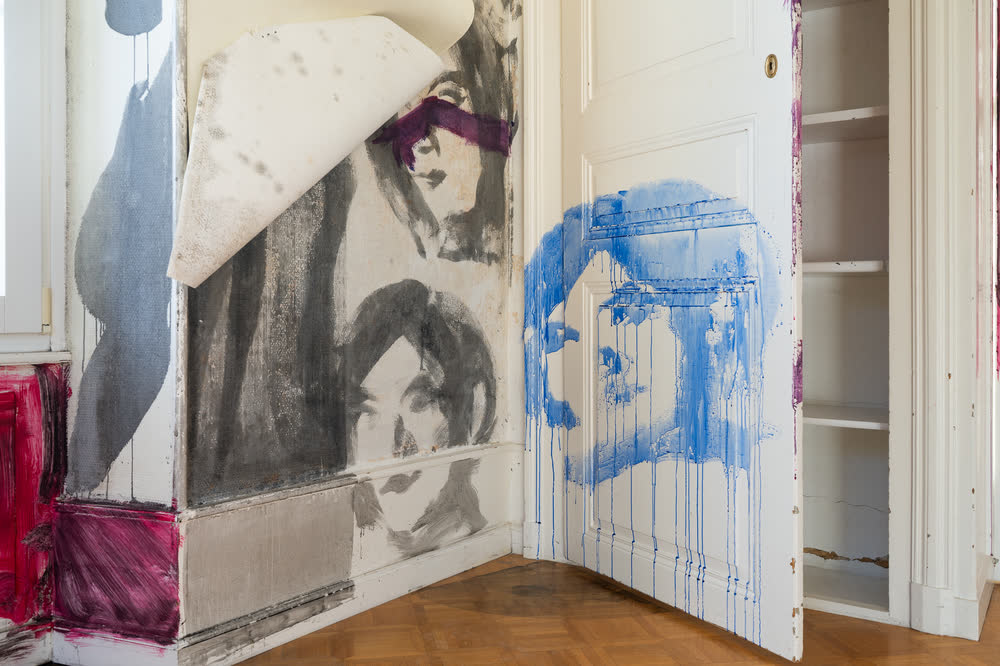
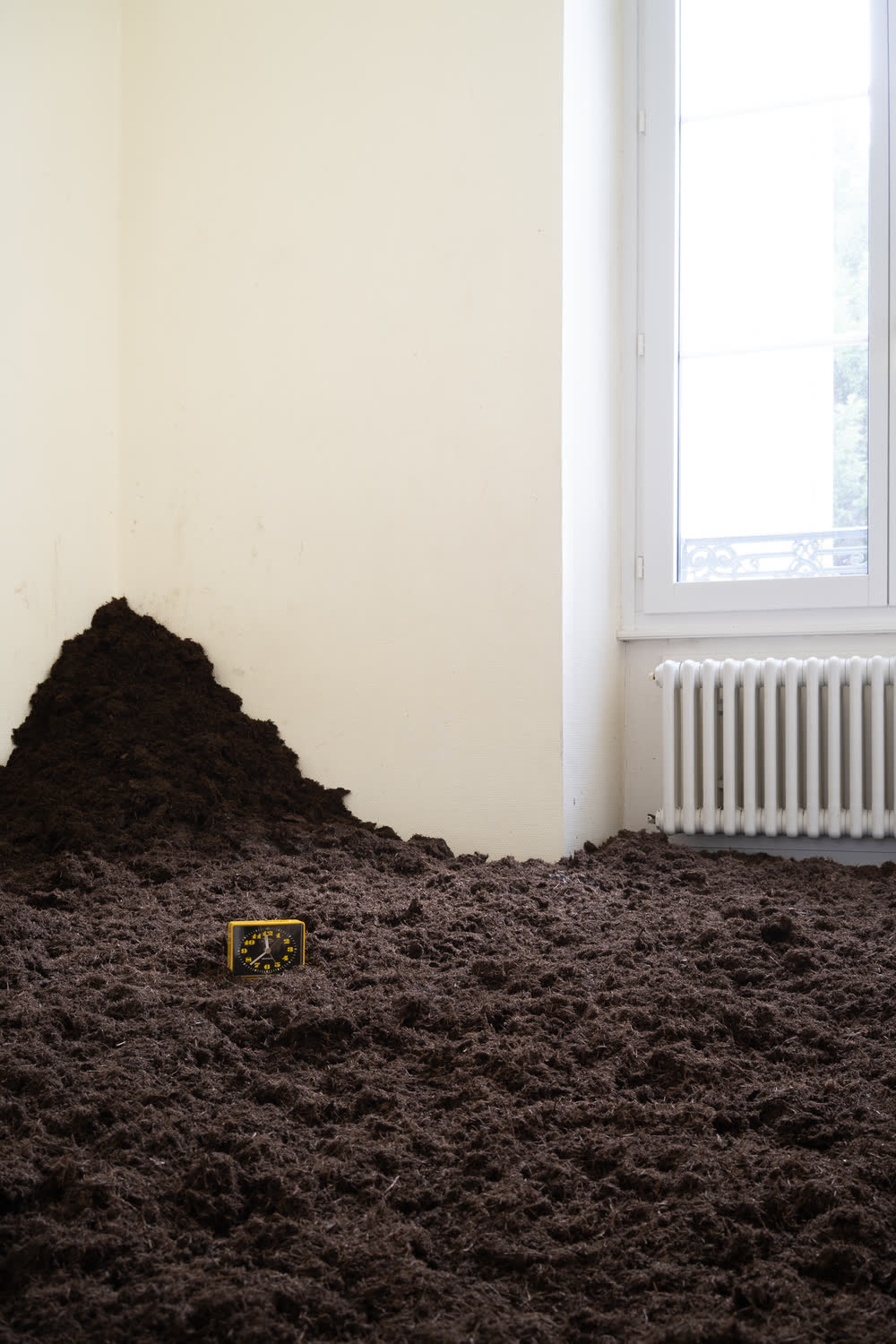
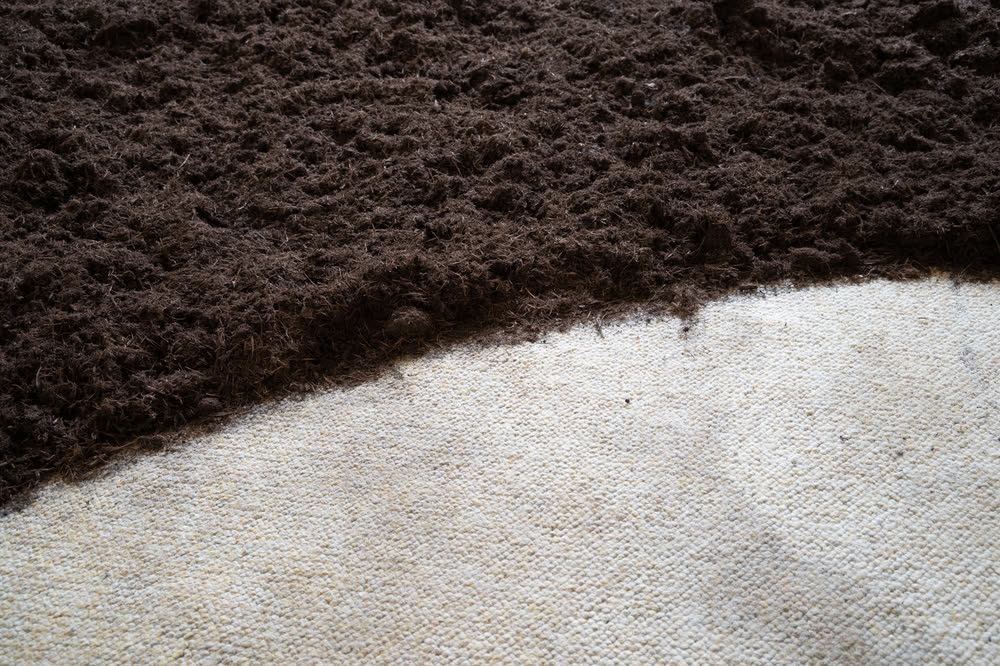
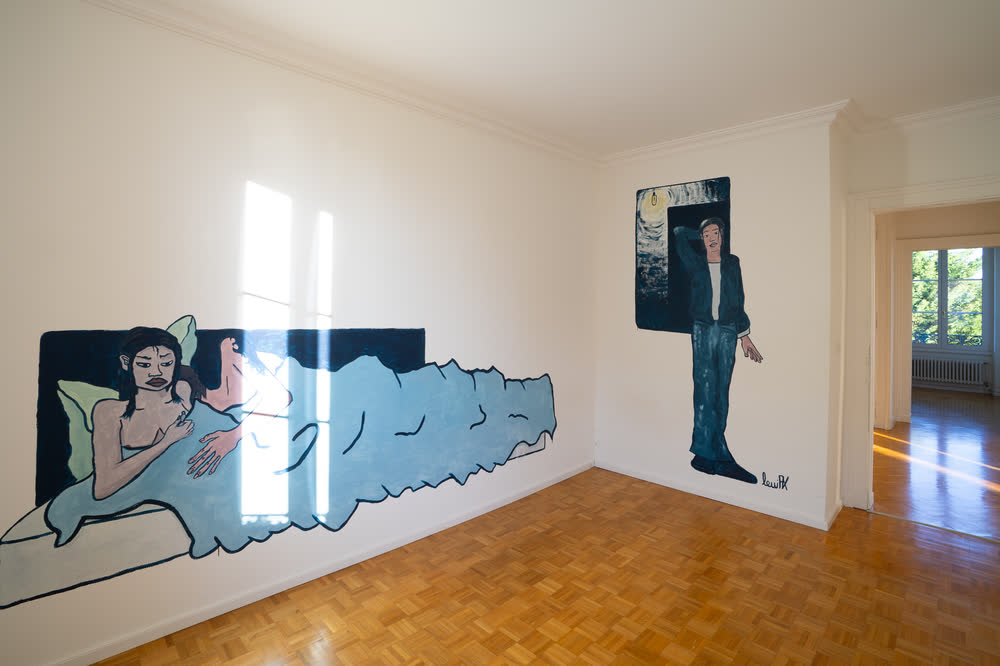
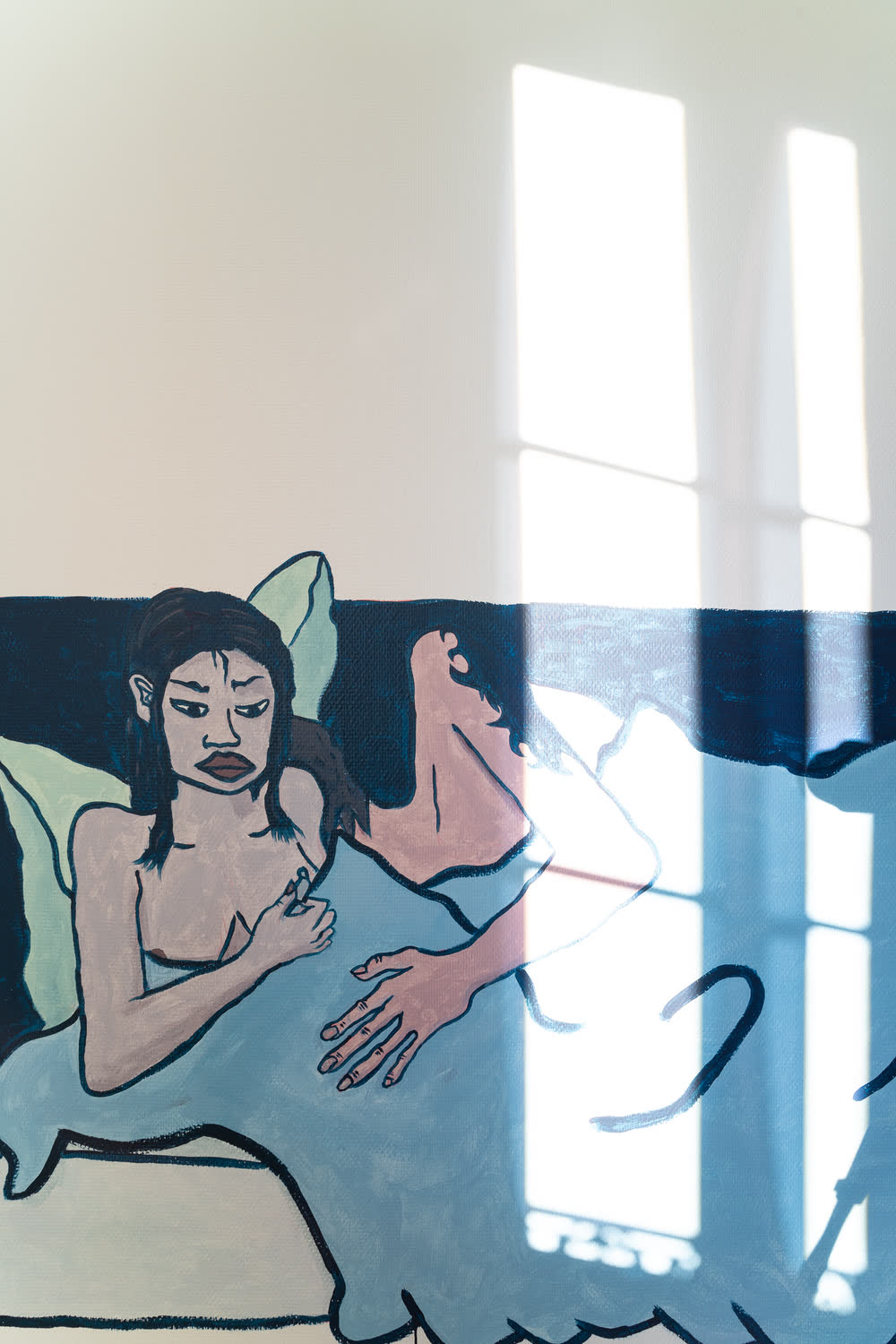
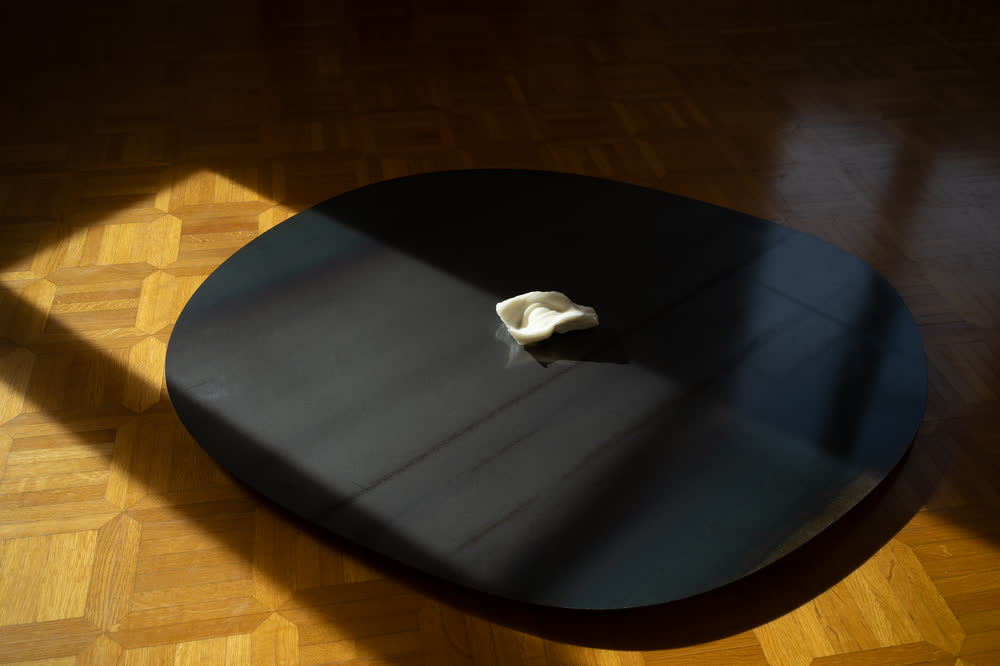
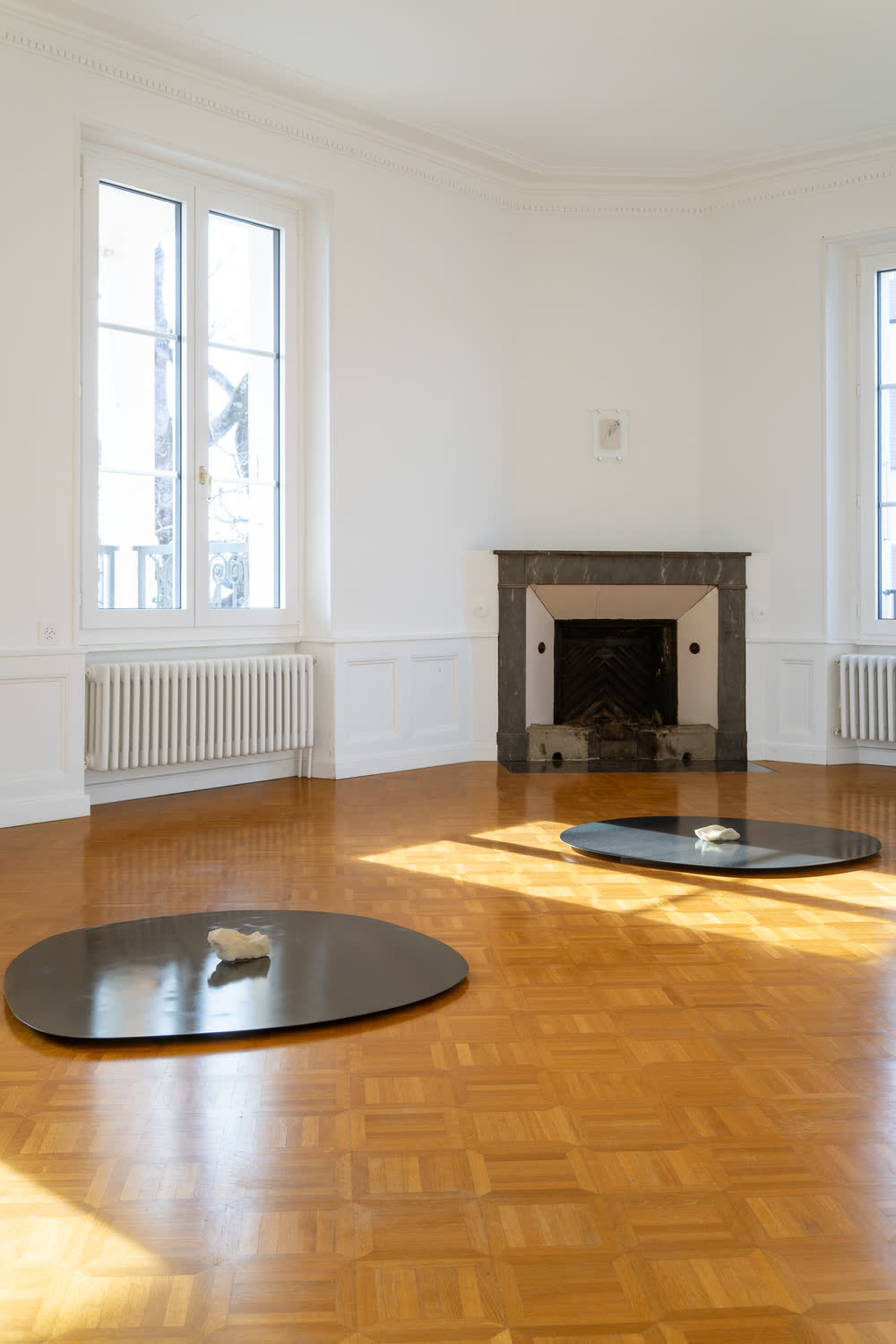
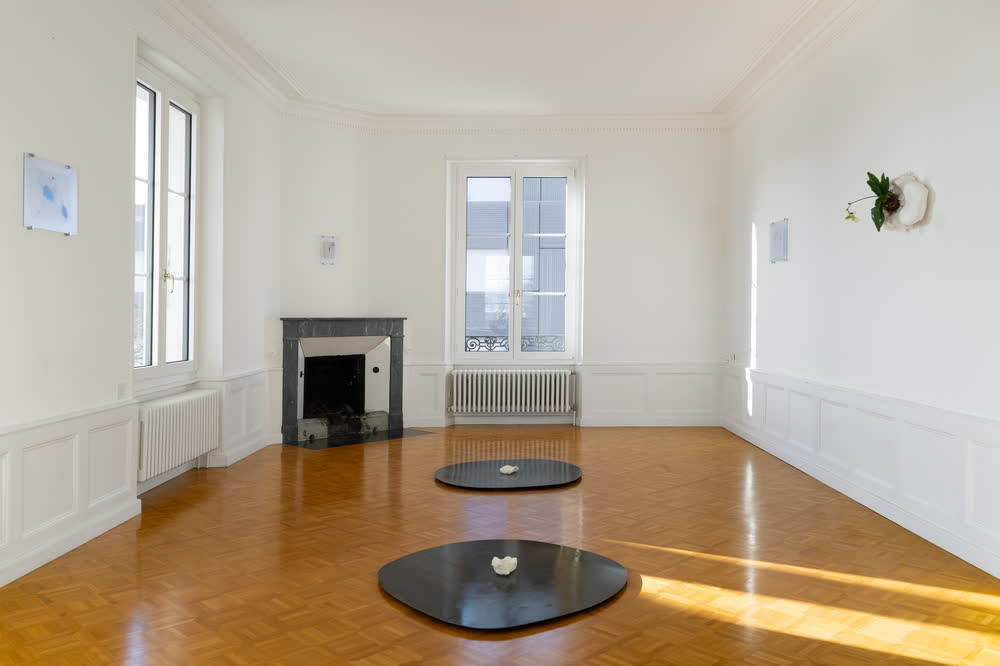
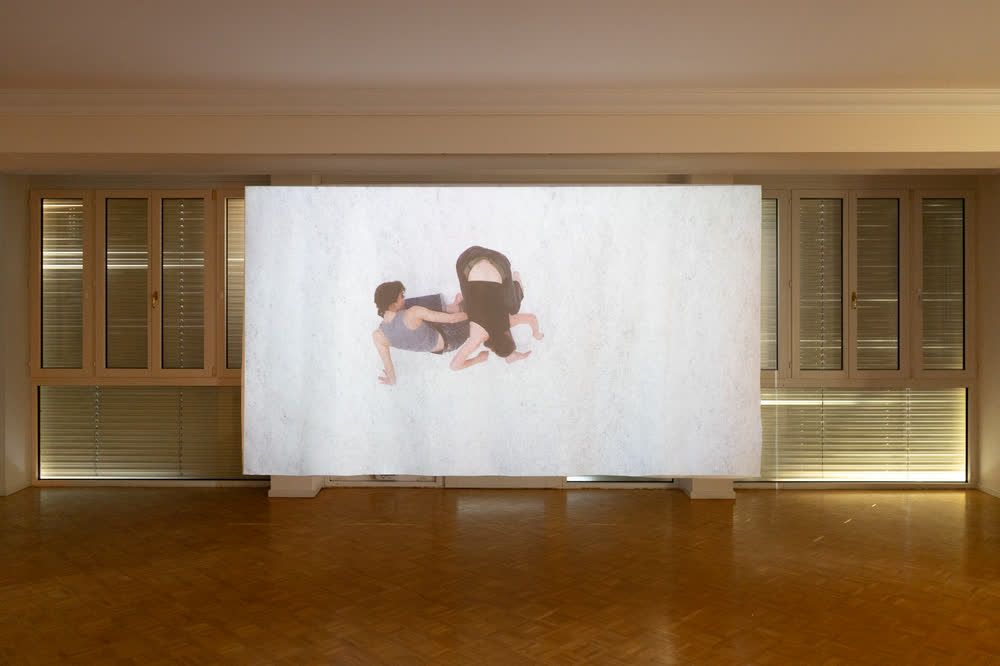
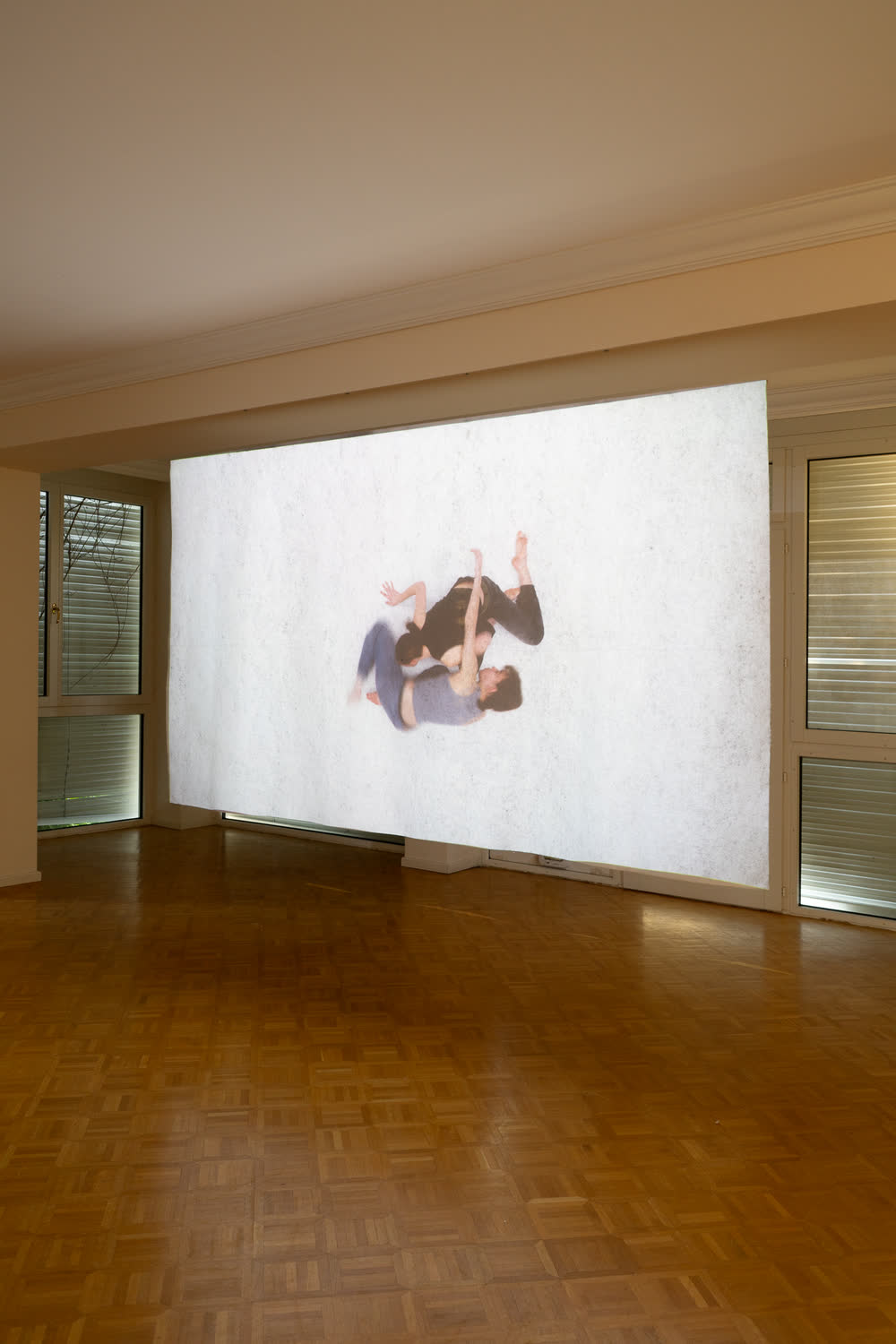
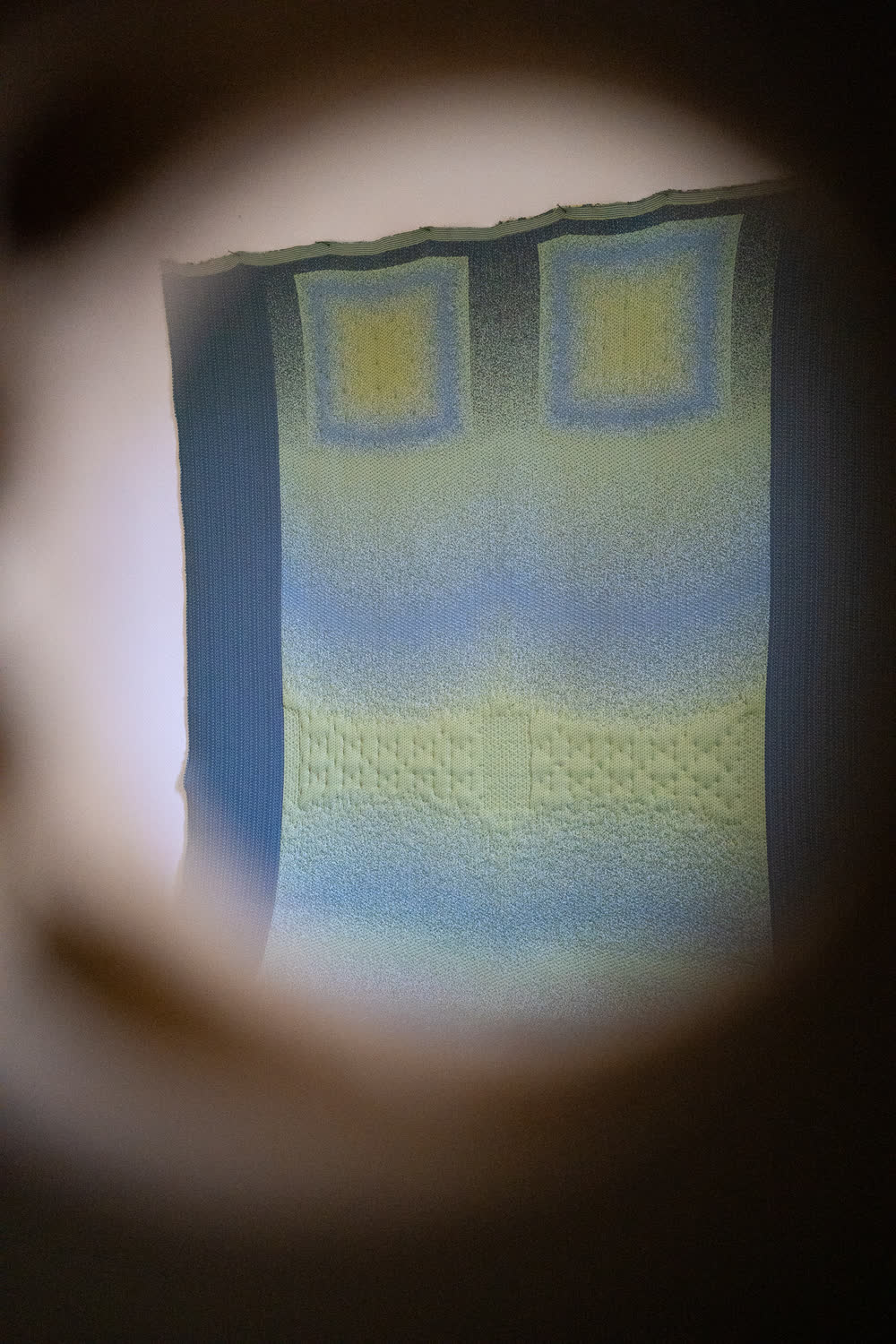
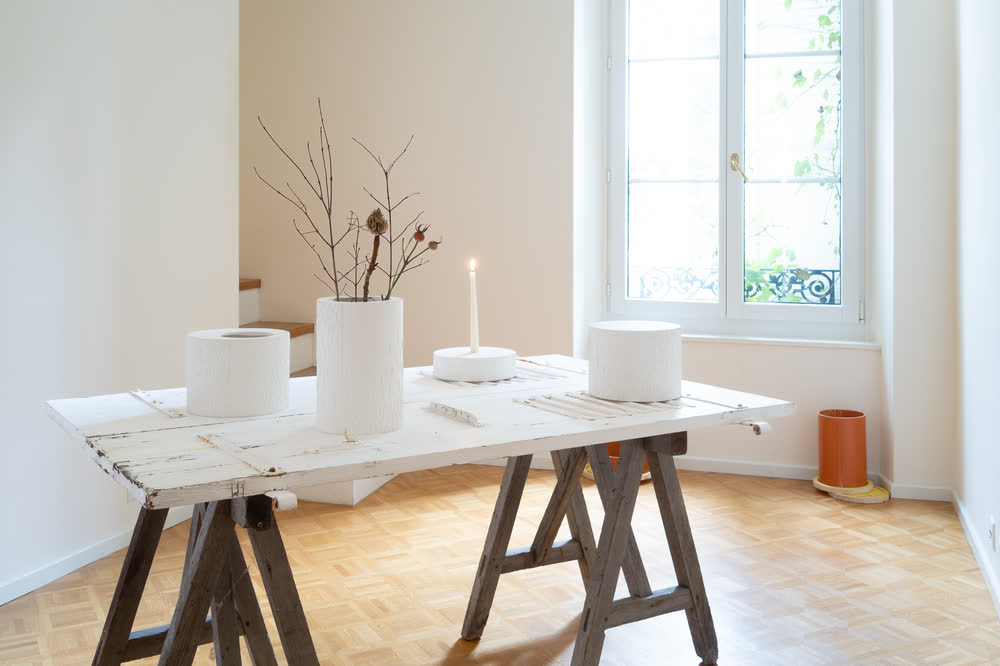
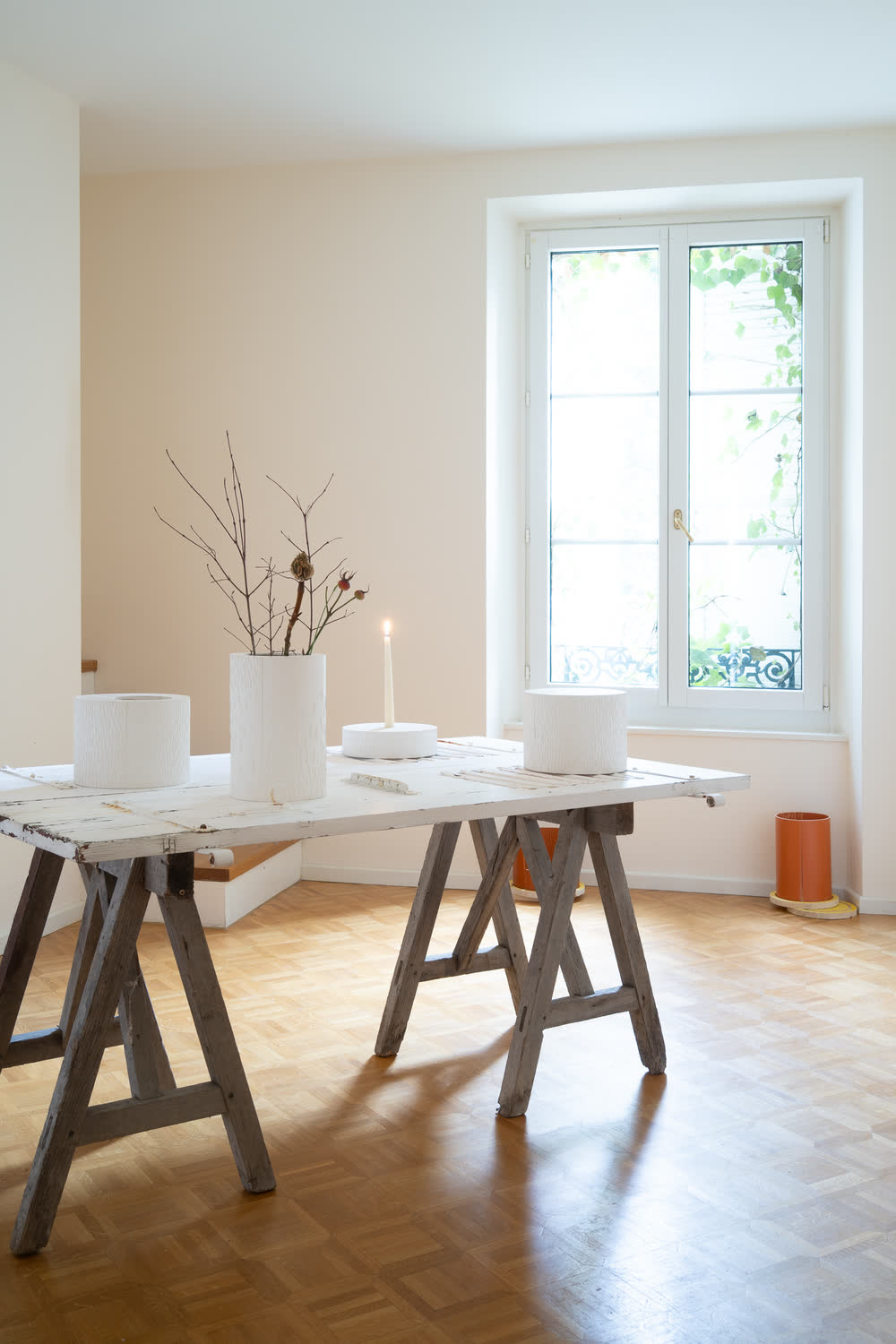
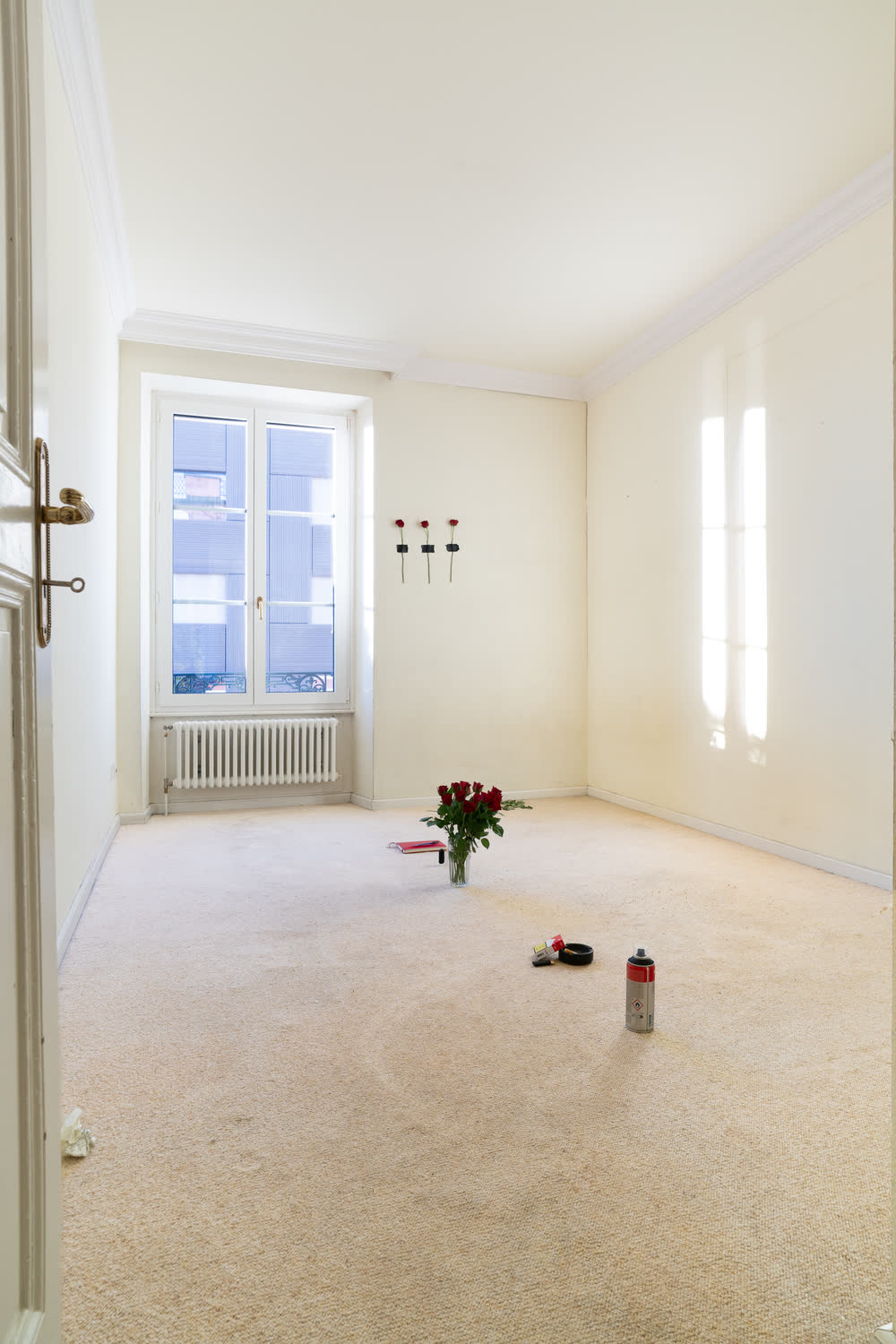
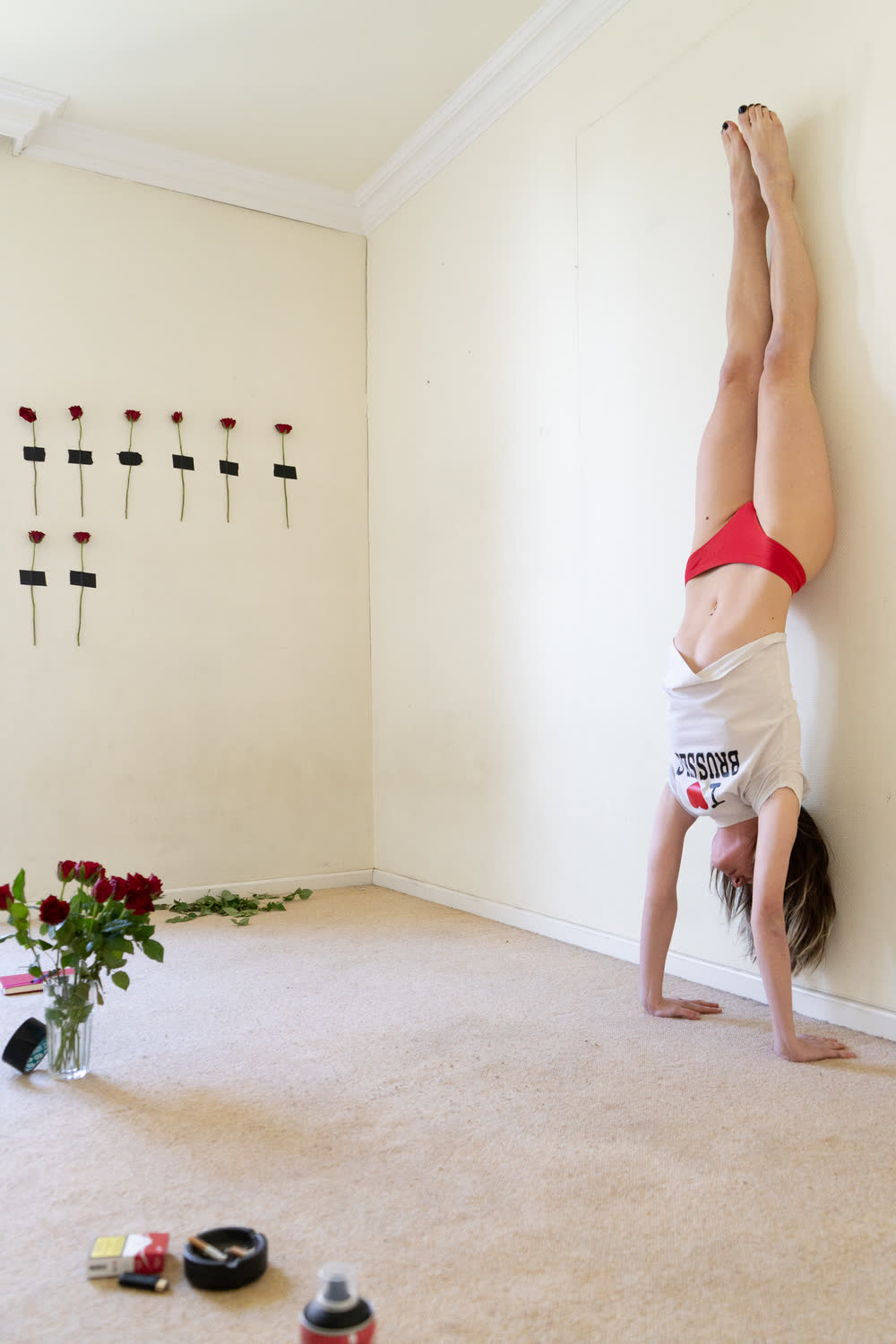
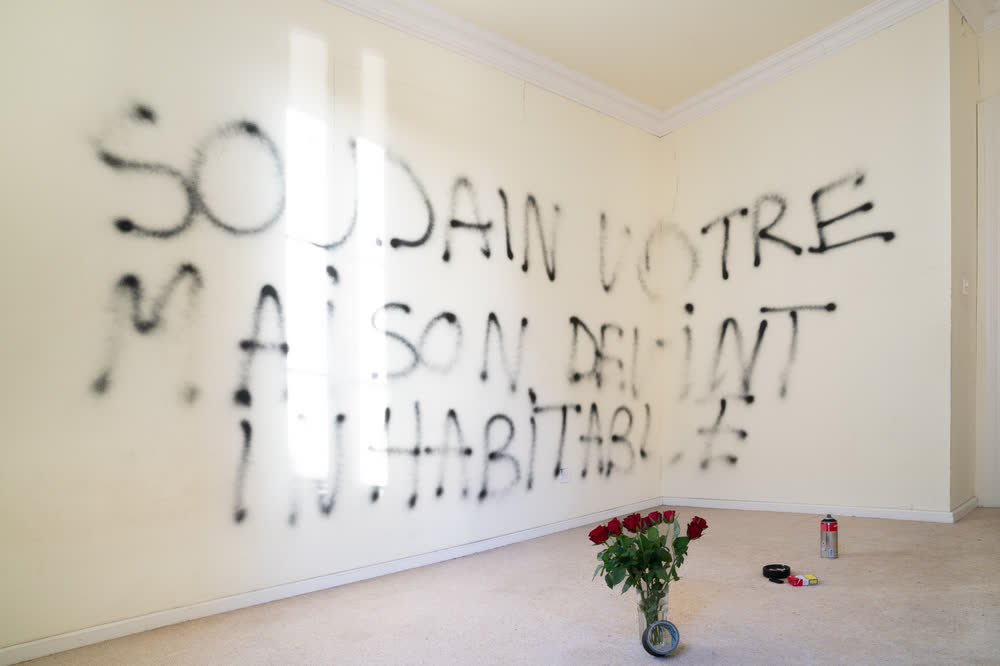
Installation views of Maison X, 2026. Photos: Tamarine Schreiber / Archives Sensibles.
Maison X brings together ten emerging artists from the Lausanne region in a house slated for demolition, in the heart of Lausanne.
Painting, sculpture, installation, performance, dance, sound, image: each artist takes over a room of the house, with complete freedom of intervention. Conceived as a portfolio on the scale of a building, the project is documented through installation views and a filmed interview with each artist.
Wall texts
Prompt is my full body V.II, 2025
Micro-perforated tarpaulin — installation, dimensions variableThe installation Prompt is my full body V.II stages an oversized creature emerging from the ceiling. Strange and fascinating, this apparition is the result of images generated from photographs of the collective members’ bodies. Fed with these pictures, artificial intelligence is asked to produce new images. But the bodies it generates no longer resemble the originals: they transform and distort. Figures appear that recall the work of the surrealist photographer Bill Brandt — bodies with troubled proportions and stretched limbs, almost unrecognisable. Beauty lies not in perfection, but in the strangeness of this vision.
— Tamarine Schreiber, 2026
Biography
Founded in 2023 by photographer Alessia Olivieri (1992, IT), multidisciplinary artist Charlotte Olivieri (1994, CH) and art historian Audrey Zimmerli (1993, CH), ACA is an art collective based in Vevey. Their projects — combining visual arts, photography and installation — explore representations of the body and question the place of artists in today’s digital society. Together, the three members develop a collaborative practice centred on notions of (re)appropriation — of images, bodies and emotions.
La Chute des Anges, 2026
Feathers, cardboard, barbed wire, wire mesh and glue — installation, dimensions variableThe bare walls and crumbling ceiling provide the setting for La Chute des Anges. The installation bursts forth like a suspended movement: a violent fall that, like an explosion, passes through and tears apart the building. Shaped by her experience in Lebanon between 2019 and 2025, Leah Linh conceives her installation as a reinterpretation of apocalyptic cycles, where theology, politics and poetry coexist. Sacred iconography is displaced, confronted with the scars of the present and the realities of fragile territories.
Within the installation, humble and precious materials go hand in hand to sketch the fragments of a body off balance. Where the cardboard, with its exposed edges, reveals its materiality, and the barbed wire its violence, the white feathers endure as a fragile sign of hope — that “thing with feathers” evoked in Emily Dickinson’s poem (“Hope” is the Thing with Feathers, 1891).
— Tamarine Schreiber, 2026
Biography
Leah Linh, a Swiss artist of Spanish and Vietnamese descent, turned to art after completing three years of political science studies in Seville. Her humanitarian work, particularly in a psychiatric hospital in Lebanon, deeply informs her practice. She explores the contradictions between the sacred and the everyday, banal objects and powerful symbols, through monumental installations and a multidisciplinary approach. Her installations regularly occupy historic spaces, notably in her solo exhibitions at the Château de Chillon (2023), Espace Témoin in Geneva (2025) and the Église Sainte-Claire in Vevey (2025).
Where are you from ?, 2023 — series of watergrams
Sans titre and Série sans titre, 2026
Photograms, lumenprints and cyanotypes, unique piecesIn a sensitive and experimental body of work built around notions of time, place, matter and imprint, Marlène Grand casts a singular gaze on the natural elements around her. Without using a camera, the artist lets water and light leave their trace directly on the photosensitive surfaces she works with.
The series of watergrams Where are you from ? is made by exposing photographic paper under water to capture and freeze its ripples. These images act as witnesses of water — at once a vector of mobility and connection, but also of economic power. This reflection continues in a series of cyanotype photograms, presented on a table as a set of samples evoking aerial views. The deep blue characteristic of this historic process evokes the ocean, while white areas appear like fragments of melting ice. On the walls, soft pink lumenprints introduce a more unstable and ephemeral dimension. Obtained simply by exposing photosensitive paper to light, some of them, left chemically unfixed, continue to evolve: the artist thus lets time and light become co-authors of the work throughout the exhibition.
— Tamarine Schreiber, 2026
Biography
Marlène Grand is a French-Swiss photographer based in Vevey. A graduate of CEPV (Vevey School of Photography), she develops a practice centred on the fundamentals of photography: light and photosensitive material. She favours cameraless processes such as cyanotype, photogram and lumenprint, as well as analogue photography.
Doom Dream : R.E., 2026
Acrylic paint and Indian ink, salvaged strips of wallpaper — installation, dimensions variablePainted directly onto the surfaces of the room, this site-specific work takes a more playful approach than the artist’s usual methods. Projected anamorphic figures, symbols and existing features of the space intertwine in a fragmented composition informed by the imagery of video games — notably Resident Evil (Capcom, 1996) and the character Ada Wong. In the centre, a circle drawn in ink on the parquet marks the position of the tripod used for the projection, whose shapes then scatter through the space as repeated motifs and altered silhouettes, evoking both human presences and the traces of an uncertain event.
The space is built like a level to be explored, where certain elements suggest activatable objects — such as a sniper rifle hidden above the window or in the wardrobe. The painted door acts as a threshold, like a transition screen, while inside the wardrobe a hybrid figure appears, half horse, half human, drawn from a composite imagination. The salvaged strips of wallpaper act as masking elements, partially revealing the painting and the alterations of the wall. Finally, arcs drawn on the floor indicate the possible positions of open doors, suggesting an activation of the place and inviting us to see the space as a navigable environment, between projected fiction and material reality.
— Simone Nicola Filippo, 2026
Biography
Simone Nicola Filippo is a visual artist based in Neuchâtel. His practice focuses mainly on painting and extends to installation through collaborations, notably with the collective General Aesthetics. His work explores parasocial relationships, loneliness and consumer culture. Recipient of several artist residencies in Switzerland, Egypt, Mexico and Japan, he has shown his work in solo exhibitions in Switzerland, notably at Quartier Général in La Chaux-de-Fonds, as well as in numerous group exhibitions nationally and internationally.
Before Waking, 2026
Potting soil, alarm clock — installation, dimensions variableAn impassable threshold, the soil covering the room occupied by Noémie Balazs’s installation is at once an invitation and a categorical refusal. An invitation to cross the doorway and stand on the corner of carpet still free of soil, and a refusal to go any further so as not to disturb the sediment that reigns beyond, like a layer deposited by time. This soil is not there to be trampled underfoot, but gathers gently, undisturbed, outside of time…
In the manner of Walter De Maria’s Earth Room (1968), nature takes over the place: outside becomes inside. But here, in the centre of the room, an alarm clock shatters the illusion of a space abandoned to time and the elements. This banal, almost anachronistic object and its alarm, set to ring at regular intervals, abruptly reactivate temporality. They break the silence, fracture contemplation and remind us that time goes on despite the burial.
— Tamarine Schreiber, 2026
Biography
Noémie Balazs is a Swiss artist and curator who graduated in 2023 with a Bachelor in Visual Arts from HEAD – Geneva. Based in Lausanne, she is an active member of Visarte. Her practice spans photography, sculpture and installation, exploring processes of material transformation and temporality. She has joined L’Imprimerie, a shared studio and exhibition space bringing together multidisciplinary artists in Lausanne.
la chambre, 2026
Acrylic paint on wall — installation, dimensions variablela chambre is organised around several scenes in which figures unfold in tension, caught between closeness and withdrawal. On the main wall, a bed, a scene of intimacy: under the sheets, a woman sits up slightly, her gaze steady. Opposite, a man, at a distance from the group behind him, looks into the distance. He withdraws for a moment from the festivities, as if suspended in a time of his own — a moment of solitude where bodies share the same space without truly meeting. On leaving the room, a large figure with uncertain contours stands there. At once departing and arriving, it sketches a hesitant, almost unconscious gesture, as if caught in an unfinished movement.
In this room, shared moments and instants of solitude intersect. Levi Abraham’s paintings reveal an interiority at a distance, observing these fragments of experience. They show what surfaces when the gaze of others fades.
— Tamarine Schreiber, 2026
Biography
A self-taught artist based in Lausanne, Levi Abraham develops a practice rooted in an instinctive and ongoing relationship with painting and comics. Fed by a flow of images and recurring figures, his work explores the representation of the body between individual presence and collective dynamics.
Sigh, 2023 · Counterstudy, 2026 · Meditating Sterility, 2026
Laser-cut varnished steel, biopolymer, drawings on tracing paper, beeswax, living orchid…At first glance, Romain Carré’s world recalls the cabinet of curiosities — those precursors of the museum where natural objects, artefacts and collected specimens sat side by side. Far from reproducing their aesthetic or fascination, the artist offers a critical reading of them, attentive to the regimes of power underlying these devices of knowledge. Historically, such private collections helped assert cultural capital and symbolic domination, based on the extraction, classification and decontextualisation of living beings and cultures. Carré replays these logics by displacing them: he samples, assembles and transforms, while keeping visible the question of the gaze, of perspective and of the systems that produce knowledge.
On the floor, Sigh brings into play the biases inherent in human perception: eyes taken from ancient sculptures, digitised and then recomposed, materialise a constructed and situated gaze. This reflection continues in the Counterstudy works, where observational drawings are infiltrated by forms inspired by scientific imagery. By combining the study of nature with tools drawn from microscopy, the artist blurs the boundaries between representation and analysis. Finally, Meditating Sterility unfolds an unstable ecosystem mixing organic matter, smells and living organisms, where reproduction, artificiality and disappearance intertwine. The whole forms a space of experimentation in which the tools of science become speculative instruments, revealing the fragility of the frameworks through which the living is observed, understood and given form.
— Tamarine Schreiber, 2026
Biography
Romain Carré lives and works in Lausanne. He graduated in 2021 from the Istituto Universitario di Architettura in Venice, and from the Observatoire de Paris with the jury’s congratulations. His work has been shown in Switzerland and abroad, notably at the Galerie du Crous, Bissone Arte ’22, the Bonifacio Biennale, the studios of the Fonds de dotation agnès b., Palazzo Ca’Tron, the Maison régionale de l’architecture des Pays de la Loire and the Théâtre de la Ville in Paris. Coming from a background at the crossroads of art and science, his research touches on the foundations of knowledge, revealing the fragility of a discourse at the limits of the observable world.
Noeuds, 2026
Single-channel video installation, dance — with Shirine VeyratAsia Cantalupo presents research born of her fascination with the discreet details that populate everyday life. During her travels, her attention was caught by an element often found in harbours: the knot. Ropes thrown, tied, soaked, fastened, resisting the sea.
In her performance with Shirine Veyrat, Asia Cantalupo translates these knotted forms into a body language. The two performers move in a continuous, slow and gentle intertwining. Attentive to one another, they constantly oscillate between a gesture offered and a gesture yielded. As with a complex knot, the eye gets lost in their entangled bodies, unable to tell where one begins and the other ends.
This way of observing a form and extracting a “logic of movement” from it belongs to a choreographic tradition in which the body borrows the qualities of objects. Here, Asia Cantalupo borrows from knots their intertwining, tension and resistance, transforming her body into what binds, holds and connects — a true material of gesture.
— Marek M. Chojecki, 2026
Biography
Asia Cantalupo is a dancer and performance artist whose practice draws on everyday details — often discreet or forgotten — and their poetic charge. She explores their form or meaning through gesture, but also through writing and photography, at the crossroads of dance, performance and theoretical reflection. A master’s student in contemporary art history at the University of Geneva, she uses theoretical tools to question her own artistic practice.
Gravura, 2022 · Moulds for Gravura, 2022 · EC Knit MAT-08, 2025
Plaster, formwork timber, PVC, 3D knit fibre blendIn this room destined to disappear, the installation unfolds in two stages. At the entrance, Gravura brings together plaster vases shaped from recycled building materials: wood, pipes and tools left in their raw state. Each vase bears the traces of precise or spontaneous gestures, while the moulds, placed beneath the window, extend this dialogue between salvaged materials and creation. The table supporting them, made from shutters and trestles from the house, also bears witness to a second life given to the objects of the place.
Climbing a few steps, a locked door protects an intimate space. A hole invites you to crouch down to glimpse the EC Knit textile, transformed into a tapestry depicting a double bed. Here, comfort and intimacy, accessibility and reserve, the memory of gestures and an absent body intermingle. The installation creates a link between the raw and the delicate, the visible and the forbidden, celebrating the ephemeral life of a house while giving its materials and objects a last breath.
— Christophe Ascençao, 2026
Biography
Christophe Ascençao is a Swiss industrial designer and art director from the canton of Vaud, based in Zurich. Graduating with distinction from ECAL in 2025, he explores the meeting of comfort, functionality and textile innovation through a practice he describes as simple, playful and unpredictable. His diploma project EC Knit, developed with TextielLab in Tilburg, received the Swiss Design Association Bachelor Award.
home alone, 2026
Performance, rose, adhesive tape, lighter, spray paint, cigarette, ashtray, paper, nail varnishhome alone explores the teenage bedroom as a space of transition, both refuge and stage. Drawing on this familiar room where the traces of an identity in the making accumulate, Odile Fragnière questions notions of solitude, boredom, alienation and intimacy. Between everyday language and choreographed gestures, home alone replays the codes of adolescence and its unabashed “drama”, oscillating between apathy, exaltation and derision.
Digital culture and virtual connections disrupt the rhythm of the performance: the audience is invited to interact by sending messages to the performer. Each notification interrupts, alters or relaunches the flow of actions, revealing the impact of these digital exchanges on the real presence of the body. As the performance unfolds, the room gradually transforms, becoming witness to a metamorphosis: a space where one sheds a skin, the material trace of the passage from one state to another.
Odile Fragnière questions the body as a site of expression and resistance, and her gesture in Maison X belongs to a lineage of practices in which movement becomes memory — like performative research that turns the everyday into choreographic and sensitive material.
— Marek M. Chojecki, 2026
Biography
Odile Fragnière is a multidisciplinary artist born in Lausanne into a family of artists. She followed a dance-study programme until the end of upper secondary school, before completing professional training in contemporary dance at the Area Jeune Ballet in Geneva in 2024. Alongside her work as a dancer, she practises performance, to which she was introduced by the collective Public Transport Project, with whom she performed notably at Les Urbaines in 2024. Now freelance, she mainly develops solo performances based on her lived experience and her relationship to her body and her audience, incorporating a social and political dimension.
Maison X brings together ten emerging artists from the Lausanne region to take over a house soon to be demolished, in the heart of Lausanne. Painting, sculpture, installation, performance, dance, sound, image — all practices were invited, to encourage crossovers, exchanges and encounters between disciplines.
Each artist had a dedicated room, with complete freedom to take over the space according to their practice: interventions on the walls, new works, performances or the presentation of existing pieces. As the house could only welcome a limited audience, the project was conceived as a portfolio on the scale of a building: after the installation, each artist was the subject of a filmed interview presenting their intervention, approach and career.
The curatorial support, provided by Tamarine Schreiber and Marek M. Chojecki, relied on an active, caring and open presence, fostering dialogue and exchange around artistic practices. Maison X was above all built as a space for encounter and collaboration.

Founded in 2024, JarJar is a young collective exploring creation in all its forms. Through multiple collaborations — exhibitions, printed editions, a clothing label — the collective works to highlight artists and create hybrid projects. JarJar is built around exchange, dialogue and collaboration, bringing together members of the collective and invited contributors.
A collaboration between Archives Sensibles × JarJar.
Curated by Tamarine Schreiber and Marek M. Chojecki.Artists: Collectif ACA (Alessia Olivieri, Charlotte Olivieri, Audrey Zimmerli), Leah Linh, Marlène Grand, Simone Nicola Filippo, Noémie Balazs, Levi Abraham, Romain Carré, Asia Cantalupo (with Shirine Veyrat), Christophe Ascençao, Odile Fragnière.
Photographs: Tamarine Schreiber / Archives Sensibles.